

What Are Accumulators on Deriv?
Accumulators are one of Deriv’s more unique contract types — a hybrid between binary options and leveraged trading. Unlike Rise/Fall (where you predict direction at a fixed expiry) or digit strategies (where you predict the last digit), accumulators grow your payout with every tick that stays within a defined price range. The longer price stays in range, the more your stake accumulates. If price moves outside the range by even one tick, the contract ends immediately and you lose your stake.
The appeal is obvious: potential for rapid compound growth in calm, low-volatility conditions. The risk is equally clear: a single price spike at any moment ends the trade with a total loss of your stake. Understanding this trade-off in depth is essential before placing a single accumulator trade with real money.
How Accumulators Work: The Mechanics
When you place an accumulator trade on Deriv, you choose:
- Market: Typically one of the Volatility synthetic indices
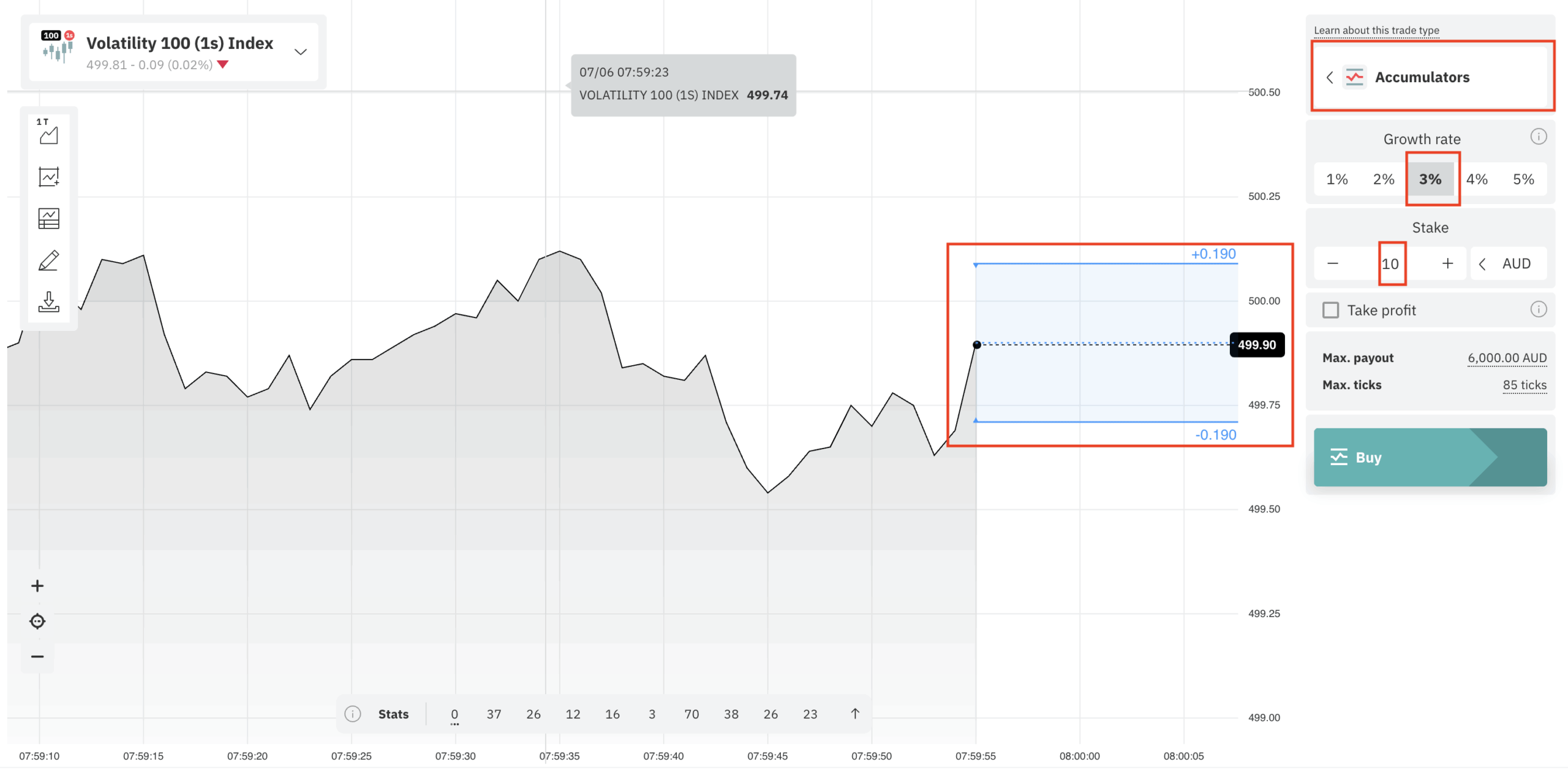
- Growth rate: The percentage your stake grows per tick while price remains in range (e.g. 1%, 2%, 3%, 4%, or 5% per tick)
- Stake: Your initial investment
Once the trade is live, the platform monitors price in real time. Around the current price, Deriv sets a barrier range — a small corridor of permitted price movement. With each tick that lands inside this range, your payout value grows by the selected growth rate. Your current payout is visible in real time.
You can take profit at any time by clicking “sell” — locking in whatever accumulated value you have built. If you do not sell and price breaches the barrier, the contract terminates and your original stake is lost.
Growth Rate vs Range Width: The Core Trade-off
The growth rate you choose directly determines how wide or narrow the barrier range is:
- Higher growth rate (e.g. 5% per tick): Faster accumulation but a much tighter barrier. Price has less room to move before the contract terminates. Higher risk, faster reward.
- Lower growth rate (e.g. 1% per tick): Slower accumulation but a wider barrier. Price has more room to fluctuate without triggering termination. Lower risk, slower reward.
For beginners, lower growth rates (1–2%) are recommended. The wider barrier gives the contract more time to accumulate meaningful value before a volatility spike ends it.
When Accumulators Work Well (and When They Do Not)
Accumulator profitability is highly dependent on market conditions:
Favourable conditions
- Low volatility periods: When price is moving within a tight range with small tick-to-tick fluctuations, accumulators can build up significant value before a spike occurs.
- Calm synthetic indices: Volatility 10 and Volatility 25 indices have smaller average tick movements than V75 or V100, making them more suitable for accumulator trading.
- After market open stabilisation: Real forex pairs sometimes enter brief low-volatility consolidation phases after the initial open — these can be favourable for accumulators at lower growth rates.
Unfavourable conditions
- High volatility periods: During news events, economic data releases, or naturally volatile market sessions, tick movements are large and frequent barrier breaches are likely.
- Trend markets: Sustained directional moves (even gradual ones) will push price outside the range relatively quickly.
- V75 and V100 indices at high growth rates: The combination of high volatility index and tight barrier is a recipe for very short-lived contracts.
Risk Management for Accumulators
Accumulators have a binary loss outcome — you either walk away with accumulated profit (by selling in time) or lose your full stake when the barrier is breached. This all-or-nothing structure makes stake sizing especially important:
- Stake no more than 1–2% of your account per accumulator trade — remember you can lose 100% of the stake on any trade
- Have a take-profit target before entering: Decide in advance at what accumulated value you will sell. For example: “I will sell when my payout reaches 150% of my original stake.” Without a target, greed often causes traders to hold too long and lose what they built.
- Do not re-enter immediately after a loss: A barrier breach means volatility is elevated. Wait for conditions to calm before placing another accumulator trade.
- Set a daily loss limit: Like all binary options contracts, apply your standard 5–6% daily loss limit across all accumulator trades combined.
Practical Take-Profit Strategy
One of the biggest challenges with accumulators is knowing when to exit. Some traders use a fixed percentage target (e.g., sell when accumulated value reaches +50% or +100% of stake). Others use time-based limits (e.g., sell after 30 ticks regardless of value). Both approaches are valid — the key is to have a rule decided before you enter, not made in the heat of the moment while watching your payout grow.
A common mistake is holding accumulators “just a little longer” after reaching a profit target, hoping to maximise the payout. The probability of a barrier breach increases with every additional tick held. Discipline to exit at your predetermined target is what separates systematic accumulator traders from gamblers.
Accumulators vs Other Deriv Contracts
| Feature | Accumulators | Rise/Fall | Even/Odd Digits |
|---|---|---|---|
| Expiry | No fixed expiry — tick by tick | Fixed time or ticks | Fixed ticks |
| Profit potential | Compounds with each tick | Fixed payout | Fixed payout |
| Loss | Full stake on any barrier breach | Full stake if wrong at expiry | Full stake if wrong at expiry |
| Market condition | Works in low volatility | Works in trending markets | Works in any condition (random) |
| Control | Can exit any time | Usually fixed until expiry | Usually fixed until expiry |
Getting Started with Accumulators Safely
Before placing an accumulator trade with real money, spend time on the Deriv demo account observing how accumulators behave on different indices and at different growth rates. Watch how quickly the barrier is breached on V75 vs V10. Experiment with different growth rates and take-profit levels. Build an intuition for how long contracts typically last under different conditions before you risk real capital.
For further reading on Deriv’s other unique contract types, see our guides on Synthetic Indices and Asian Up and Down Contracts.
About the Author
Bretton Gitonga — trading educator and founder of Money8gg. Years of hands-on experience with binary options and forex on Deriv. Contact Bretton.