
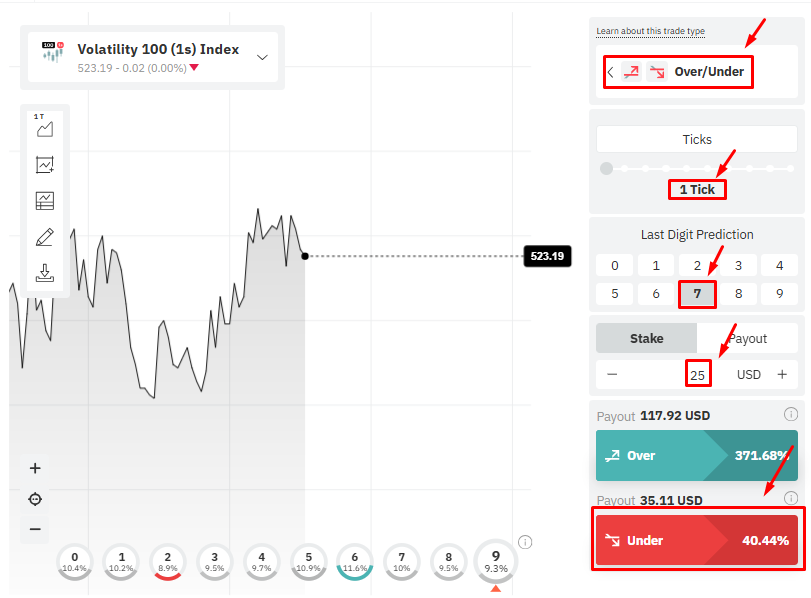

What Is the Under 7 Strategy?
The Under 7 digit strategy is a contract-based approach on the Deriv platform where you predict that the last digit of the settlement price will be 6 or lower — specifically 0, 1, 2, 3, 4, 5, or 6. That gives you 7 winning outcomes out of 10 possible digits, producing a theoretical win rate of 70%.
Under 7 is one of the more popular digit strategies among Deriv traders because the 70% theoretical win rate feels achievable and the pace of trading is fast enough to generate meaningful data relatively quickly. However, like all digit strategies, its profitability depends entirely on whether the payout offered exceeds your breakeven threshold — which is not always the case.
The Probability Mathematics
The foundation of any digit strategy is the underlying probability. For Under 7:
- Winning digits: 0, 1, 2, 3, 4, 5, 6 — seven outcomes
- Losing digits: 7, 8, 9 — three outcomes
- Theoretical win rate: 7 ÷ 10 = 70%
Breakeven win rate formula: 100 ÷ (100 + Payout %)
| Payout Offered | Breakeven Win Rate | Edge at 70% Win Rate |
|---|---|---|
| 25% | 80.0% | Negative — skip |
| 35% | 74.1% | Negative — skip |
| 43% | 70.0% | Breakeven — marginal |
| 50% | 66.7% | Positive (+3.3%) |
| 60% | 62.5% | Positive (+7.5%) |
Under 7 typically offers lower payouts than riskier digit contracts (like Over 5 or Under 4) precisely because its win rate is higher. The payout adjusts to reflect the probability. You must check the live payout on Deriv before confirming any trade — it changes in real time based on market conditions.
Key rule: Only place an Under 7 trade when the displayed payout is at or above the level where your theoretical win rate produces a positive expected value. At payouts below approximately 43%, Under 7 has negative expectancy regardless of win rate.
Why Traders Like Under 7
Several practical features make Under 7 appealing as a digit strategy for beginners and intermediate traders:
- High win rate reduces emotional strain: Winning 7 out of 10 trades on average feels more manageable psychologically than strategies where you lose more often than you win. Losing streaks are shorter on average, which is easier for newer traders to handle.
- Fast feedback loop: Digit contracts settle in seconds (5–10 ticks at 1-second intervals = 5–10 seconds). You can run a meaningful session of 15–20 trades in 5–10 minutes, giving you rapid data on your execution.
- Simple entry decision: The only decision on each trade is whether the payout exceeds your threshold. There is no chart analysis, trend identification, or complex condition assessment. This simplicity makes it easier to stay disciplined.
- Available 24/7: Trading on Deriv’s synthetic indices means Under 7 can be traded at any time, including weekends, regardless of global market hours.
Step-by-Step: How to Place an Under 7 Trade on Deriv
- Log into Deriv and open DTrader
- Select a synthetic index — Volatility 10 (1s), Volatility 25 (1s), or Step Index are most common for digit strategies
- Under trade type, select Digits
- Choose Under and set the barrier to 7
- Set your tick count (5 or 10 ticks recommended)
- Enter your stake — remember: maximum 1–2% of your account balance
- Check the payout. If it is below your minimum threshold, do not place the trade
- Confirm the trade and immediately record it in your journal
Risk Management Rules for Under 7
No matter how high the theoretical win rate, strict risk management is non-negotiable:
- Stake size: 1–2% of account balance per trade — never more
- Daily loss limit: 5–6% of account balance. Stop trading for the day when you hit it
- Session trade limit: 15–20 trades maximum for beginners. Quality over volume.
- No Martingale: Even at 70% win rate, losing streaks of 5–7 trades occur regularly. Doubling after losses amplifies these streaks into account-ending losses
- Payout filter: Walk away from any trade where the displayed payout does not meet your minimum threshold — even if you feel the urge to trade
Under 7 vs Other Digit Strategies: Where It Fits
| Strategy | Win Rate | Typical Payout | Risk Level |
|---|---|---|---|
| Under 9 | 90% | Very low (5–15%) | Very low risk, minimal profit potential |
| Under 8 | 80% | Low (15–30%) | Low risk, low reward |
| Under 7 | 70% | Medium (35–60%) | Balanced |
| Under 6 | 60% | Higher (60–80%) | Medium risk |
| Under 5 | 50% | High (80–100%+) | High risk, near coin flip |
Under 7 sits in the balanced middle: win rate high enough to keep losing streaks short, payout often high enough to generate positive expectancy when conditions are right.
Demo Testing Protocol for Under 7
Before trading Under 7 with real money, run a structured demo test:
- Open your Deriv demo account
- Set stakes at a fixed percentage (e.g., 2% of your demo balance per trade)
- Place 100 Under 7 trades, recording each payout received and result (win/loss)
- At the end, calculate: actual win rate, average payout received, and total profit/loss
- If actual win rate exceeds your breakeven rate at average payouts received, you have evidence worth building on
- If not — adjust your payout filter threshold and repeat before going live
Final Thoughts
Under 7 is a solid entry point into digit strategies on Deriv. Its 70% theoretical win rate is genuinely achievable over a reasonable sample size, and when the payout is favourable, the math supports profitable trading. The discipline required is not in finding setups — it is in checking payouts before every trade, keeping stakes small, and never letting a losing streak push you into Martingale or revenge trading.
Learn more in our Over/Under Complete Strategy Guide, or practise your approach first using our Trading Journal Guide.
About the Author
Bretton Gitonga — trading educator and founder of Money8gg. Years of hands-on experience with binary options and forex on Deriv. Contact Bretton.